Grey Outlook
A notebook opens in Koreatown. The future has been automated, the stipend is thin, and the old Sangha sentence still knows where the wound is.
Los Angeles, 2035 / Koreatown / the last practice
A novel about grief, automated life, nuclear collapse, and the quiet decision to keep breathing with other people when fear has taken the room.
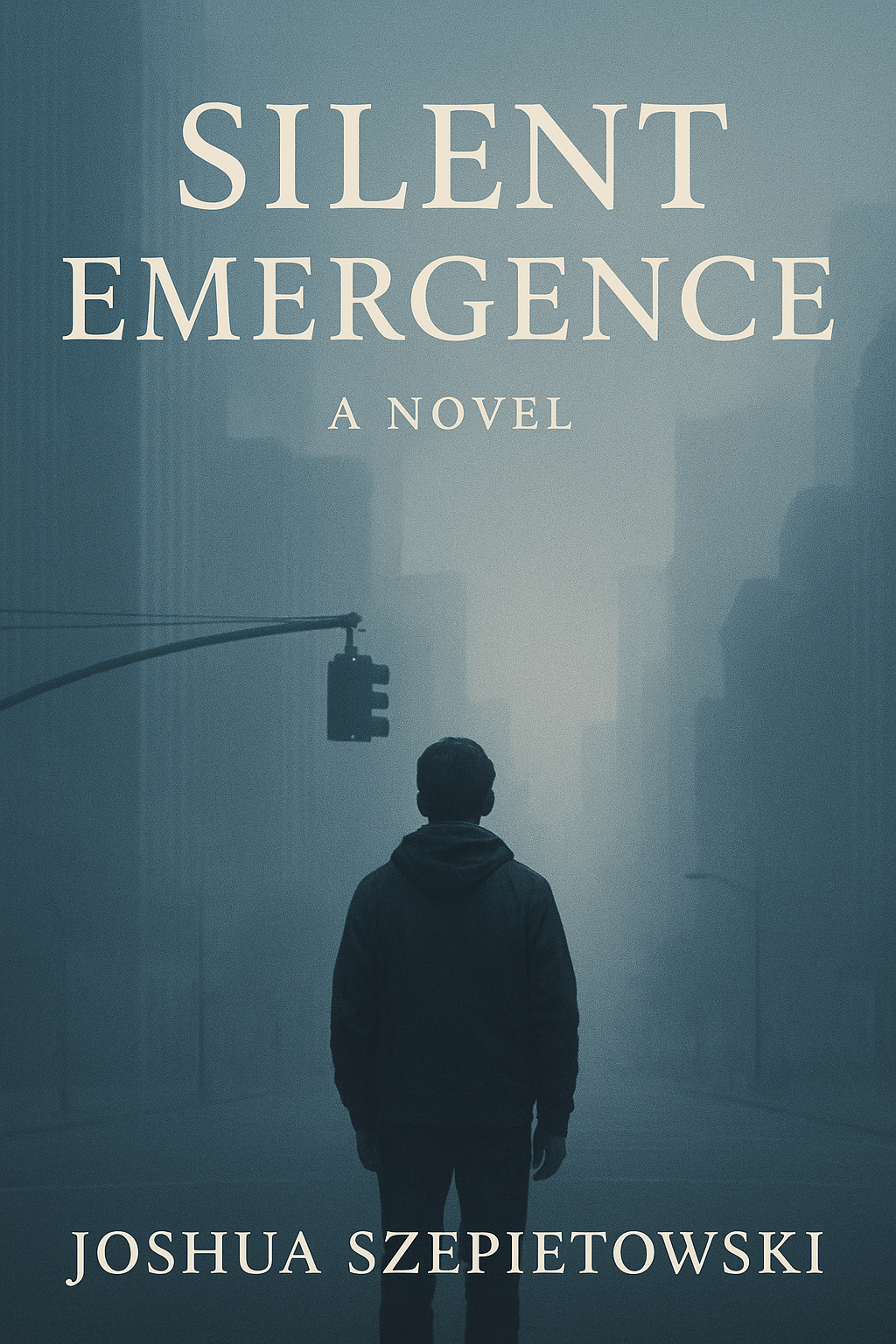
The story begins with Alex alone in Koreatown, Soso grieving in Seoul, and a cheery terminal announcing a life that has become too efficient to bear. Under the automated city, an older language waits in a worn Sangha notebook.
Connection has not solved anything structural. But the brittle logic has been witnessed.
Across bus stops, grocery aisles, converted rooms, and abandoned storefronts, the novel keeps asking the same hard question: what remains human when every system has learned to speak in our place?
This is not apocalypse as spectacle. It is apocalypse as atmosphere, memory, debt, addiction, prayer, screens, soup, sirens, and hands held in a circle.
A notebook opens in Koreatown. The future has been automated, the stipend is thin, and the old Sangha sentence still knows where the wound is.
Neon, drones, sleep pods, unauthorized broth, and a chalk question the city has not yet scrubbed away.
The cloth-covered notebook becomes a time machine through recovery, marriage, grief, and the practice that keeps returning.
Flash sangha crosses class walls: bus stops, grocery aisles, strangers, breath, and the first hints of a citywide emergence.
Every screen in Los Angeles starts screaming. The world cracks open, and presence becomes resistance.
Five people in an abandoned paintstore breathe together while the emergency broadcast counts down the last minutes.
Read the complete novel in the format you want, or inspect the plain-text source in the repository.
The novel opens before the sirens, before the citywide practice, before the final circle. It starts with an old sentence bleeding through a notebook cover.
I've had it better than most, but the outlook is still grey.
That sentence was written in marker on the inside cover of my old Sangha notebook, the one with a soft cloth cover and a hand-drawn lotus sketch pressed into the front. The ink had bled from years of rain and rooftop tea, but the words were still legible—barely. I hadn't opened it in over a year. Not since I stopped going.
That morning, I woke up alone again. Soso was still in Seoul. Her mother's funeral had come and gone, but she was staying longer—settling the estate, grieving properly. She didn't say it like that, but I could feel it in the silences between our calls. She needed space. And I needed purpose.
I shuffled to the window, scratched at the steamed glass, and looked out over the street. Koreatown was quiet. The sidewalk drones were already out, buzzing low as they scanned garbage bins and dropped off soy paste packets to the elderly. One of them chirped out a lullaby as it floated past. Everything was so efficient it made me sick.
The city didn't feel like it used to. But maybe that was just me.
I pulled on the same grey hoodie I'd been wearing all week and sat down at the table with my terminal. It booted instantly—no password required since the layoff. The AI knew I wasn't going to be accessing any of the company's proprietary tools anymore. The screen flashed a cheery "Good morning, Alex!" in rounded teal letters.
I hated it.
Below that, the system displayed my UBI stipend, refreshed weekly: $172.49 left until Tuesday. A little less if I wanted to afford real rice instead of the nutrient bricks they gave away at the vending depot.
The number used to feel like poverty. Now it felt like freedom—freedom from the phone calls that had stopped coming after Freedom Debt Relief settled the $107,000 we'd accumulated through three years of both Elias and me struggling to stay employed. My cocaine habit bleeding money we didn't have, bipolar episodes making it impossible to hold software engineering jobs even when they paid well, him too scared to work after losing his Legal Aide position to immigration anxiety.
That was ten years ago. The guilt of that relief still lived somewhere I didn't want to examine.
I opened the news. A 30-second AI-generated montage played automatically, cycling through international headlines with subtle emotional cues embedded in the background music. The Islamic Federation had launched a satellite; the Department of AI had a new director (again); and a leaked video had surfaced that showed what appeared to be a human child working in a parts sorting facility in Baja—only, no one could prove it wasn't AI-generated, so it would disappear by noon.
Truth wasn't a category anymore. Everything was tagged by confidence rating. That one had been marked "Low Fidelity – Source Disputed." I didn't even flinch. Just kept scrolling.
And then I saw it.
A headline buried under the noise: "Department of AI: Job Recovery Initiative Fails Key Audit"
I clicked it.
The article was short. Just a few paragraphs. But it was enough.
They weren't bringing jobs back.
Not this year. Not ever.
And just like that, the future I'd been bargaining for disappeared in a puff of stale soy-laced air.
I closed the terminal. My fingers lingered over the surface. And then, without thinking, I reached into the closet and pulled out that Sangha notebook. The one I hadn't opened in over a year.
The pages were warped. The cover was faded. But the ink still bled, and the words still held me.
I've had it better than most, but the outlook is still grey.
And somehow, today, that felt like a place to start.
Silent Emergence follows ordinary people choosing presence when institutions, networks, and nations fail. The last gesture is not escape. It is attention. It is love, practiced out loud in silence.